

Honghub Unveils 2026 OPC Insight Report, Revealing China’s One-Person Company Boom and a 72x AI Labor Advantage
Hangzhou, China, April 29, 2026 (GLOBE NEWSWIRE) -- A structural shift in the unit economics of tech entrepreneurship is underway. For every dollar spent on AI tooling, the equivalent developer labor now costs approximately $72 — a ratio documented for the first time in the 2026 OPC Insight Report: Gravity, Leverage & Evolution, released by Honghub, China’s first accelerator community dedicated to one-person companies (OPCs).
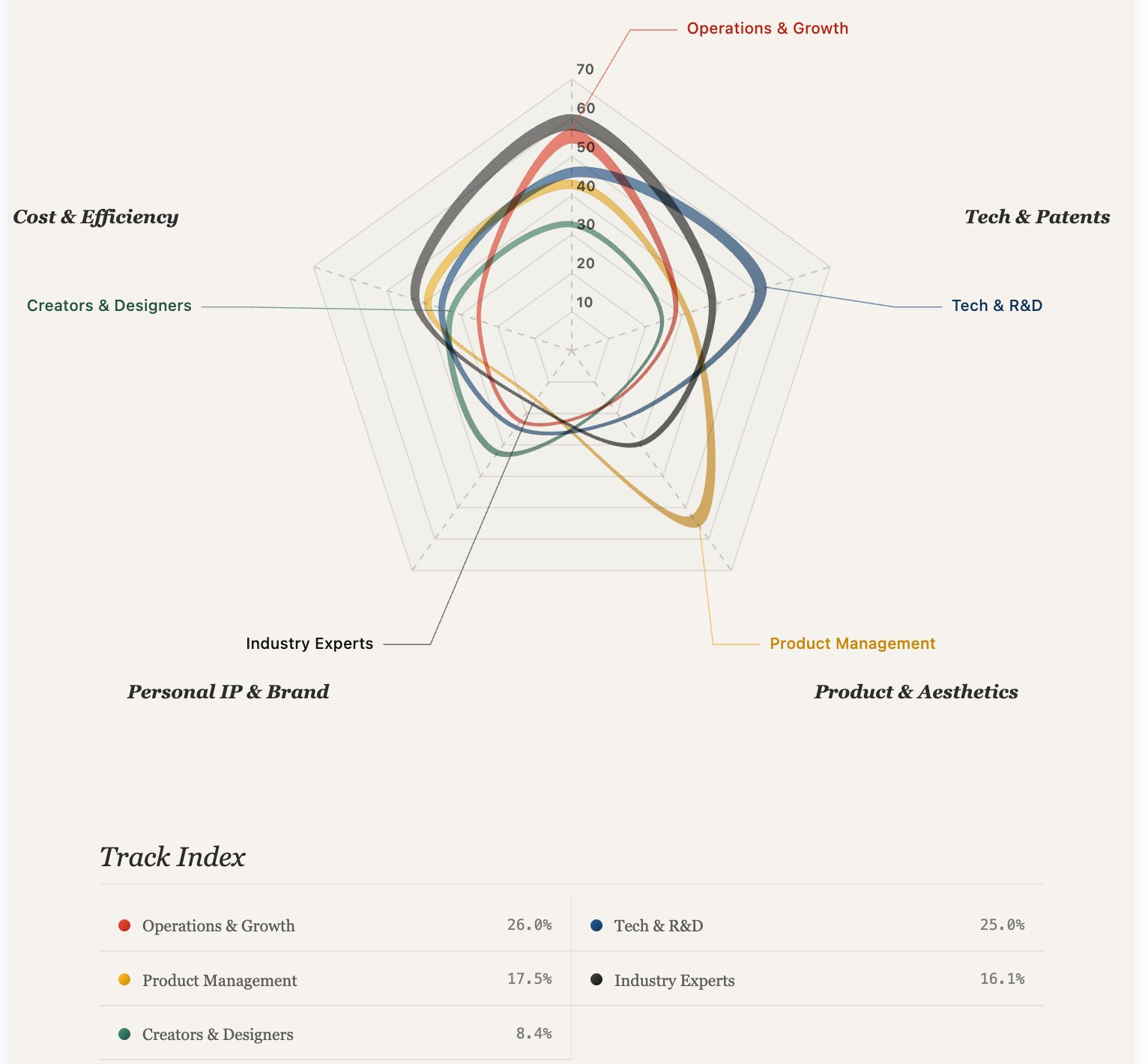
The report, based on more than 1,500 surveys and 100 hours of in-depth interviews, reveals that the cost barrier to starting a technology company has effectively collapsed. Today, 75% of solo founders come from non-technical backgrounds — operations and growth specialists (26%) and engineers (25%) are nearly tied at the top. This stands in sharp contrast to the pre-2020 era, when computer-science graduates made up the overwhelming majority of China’s independent developer community.
Researchers attribute this “democratization of building” to the collapse of the marginal cost of code production. When AI can generate UI and logic on demand, technical barriers are replaced by industry domain expertise, user insight, and commercial judgment. Even among technical founders, nearly half now prioritize “industry knowledge” over technical patent moats as their core competitive advantage.
Honghub defines a one-person company as a solo operator who uses AI as core leverage to build, ship, and scale products or systems that serve a global market, structured as a formal business entity. The distinction from freelancing is deliberate: an OPC founder is not selling time. They are building something that runs without them in the room.
The Rise of the “Non-Code” Founder
The report marks a decisive end to the engineer-dominated era of independent development. As AI handles code generation, the primary bottleneck for startups has shifted from technical execution to industry domain expertise and problem identification.
“We are seeing a new class of Industry Translators and Experience Curators who use AI as their core workforce,” said Zou Ling, founder of Honghub. “These founders are not selling their time — they are building autonomous systems that run globally without them in the room.”
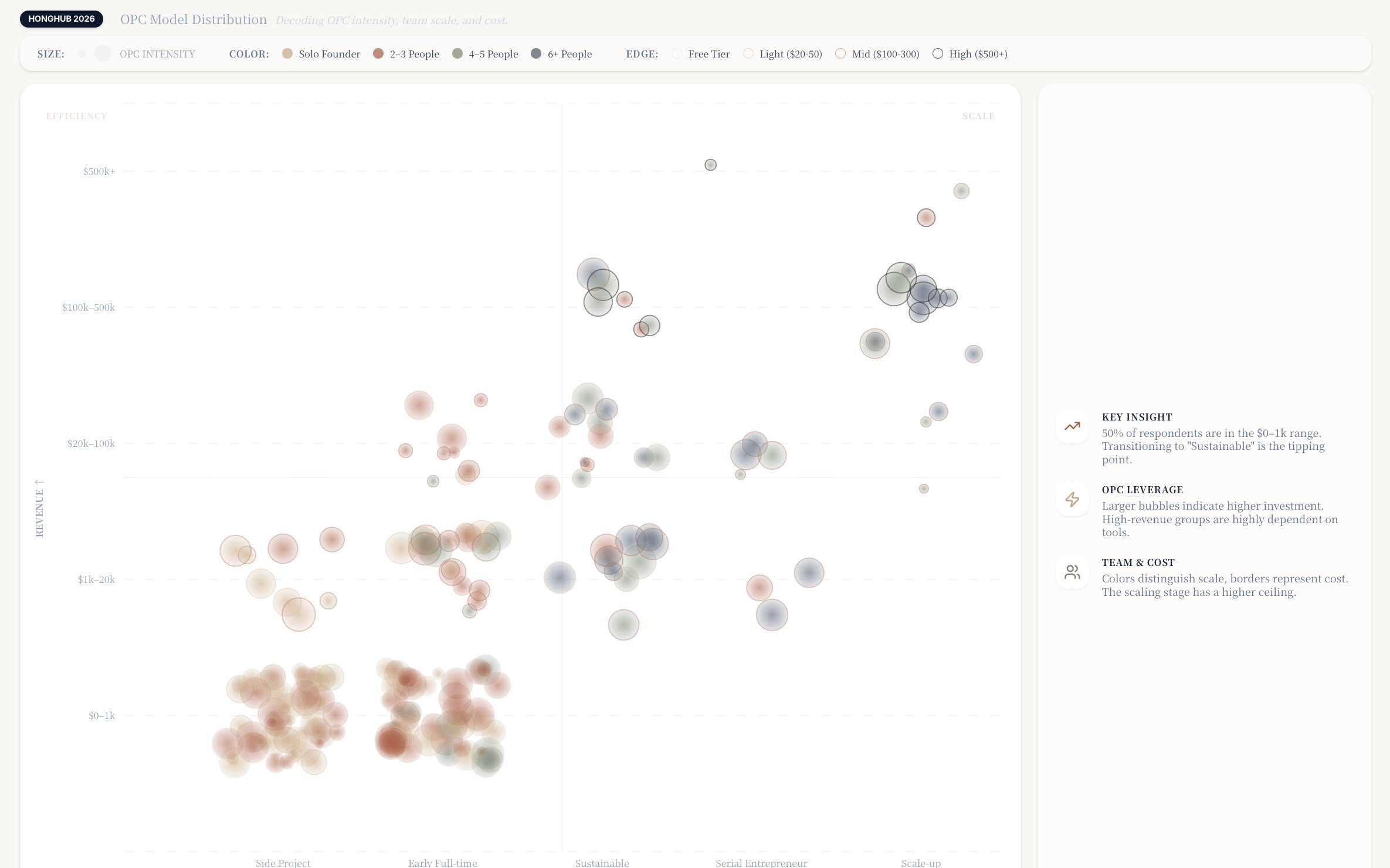
AI spending reflects this new profile. The median monthly AI tool expenditure among surveyed founders sits at approximately $39 — enough to cover roughly two frontier-model subscriptions. Only 17.6% report zero AI spend, meaning more than 82% have entered the paid tools market.
At the upper end, 20% spend more than $200 per month, typically combining API usage, cloud compute, and vertical SaaS tools on top of standard LLM subscriptions.
The report defines these costs as “Digital Office Rent.” Unlike the traditional startup model centered on headcount and fixed assets, the AI-era cost structure is characterized by monthly, variable, and instantly adjustable tool-based operating expenditure.
To quantify AI’s impact on solo companies, the report introduces HACR — the Human-AI Cost Ratio — calculated against China’s National Bureau of Statistics 2024 wage data for the software and IT services sector, adjusted for mandatory employer social-insurance contributions. The result: for every dollar spent on AI tooling, the equivalent developer labor costs approximately $72. Honghub will track the ratio annually.
OPC’s Isolation Tax: Community as Infrastructure
While the economics of OPCs are highly efficient, the psychological costs are often omitted from the balance sheet. Solo founders act as their own CTO, CMO, and CFO, often leading to acute decision fatigue with no internal safety net.
Honghub’s research suggests that traditional sentiment analysis fails to capture the true depth of this isolation. Standard sentiment analysis of interview transcripts logged anxiety at 11%, doubt at 8%, and loneliness at 7% of emotional vocabulary. But the research team argues those numbers are materially understated.
A large share of founders never use clinical emotion labels at all; they reach instead for metaphor. Phrases like “empty warehouse period,” “tunnel moment,” “muscle-weakness moment,” and “isolated exhaustion” appear throughout the transcripts — each carrying high emotional charge that conventional keyword scanning would miss entirely. The report classifies OPC emotional life as a high-amplitude oscillation system, and identifies cognitive reframing as the near-universal coping mechanism.
In response to this structural challenge, the policy environment in China has pivoted rapidly. Since October 2025, 23 major cities — including Shenzhen, Shanghai, and Beijing — have launched dedicated support frameworks for one-person companies.
However, the report argues that for the OPC economy to scale, community must be viewed not as a social support group, but as infrastructure for “productive friction.”
Data from within Honghub’s own community put specific numbers on what community membership actually changes: 20% of members redirected their business after joining; 30% validated product-market fit through community interaction that they could not have replicated alone.
“The value of community lies not only in the support it provides, but in the friction,” said Zou Ling.
Zhang Jinhui, founder of the AI comic platform Humify, pivoted her entire strategy from AI music to short-drama content after community exchanges helped her stress-test the model.
Similarly, Zhang Xiangxi, founder of Kuangxiang Qino, leveraged peer-to-peer friction to move away from a psychology-focused product — a sector plagued by long trust cycles and slow conversion — into the more immediate knowledge management space. These founders are not just looking for networking; they are using community as “validation infrastructure” to correct product drift in real time, achieving in weeks what used to take months of isolated trial and error.
The report concludes that the solo-founder economy is currently in a state of “oversupply of building capability and shortage of acquisition capacity.” In this environment, the ultimate competitive advantage shifts to founders who can bridge the gap between AI-driven production and real-world market traction.
About Honghub
Honghub (鸿鹄汇) is China’s first accelerator community dedicated to one-person companies, based in Hangzhou. It provides solo founders with validation infrastructure, peer networks, and access to resources across product, marketing, and capital. Honghub has plans to establish offices outside China to support OPC incubation in international markets. The full 2026 OPC Insight Report is available at honghub.com.
Honghub has received more than 1,000 project applications to date. Of these, more than 40 AI-powered OPC projects have joined the community, spanning sectors including entertainment, education, enterprise management, and finance.

AnnaZ, Contact@honghub.com
Legal Disclaimer:
EIN Presswire provides this news content "as is" without warranty of any kind. We do not accept any responsibility or liability for the accuracy, content, images, videos, licenses, completeness, legality, or reliability of the information contained in this article. If you have any complaints or copyright issues related to this article, kindly contact the author above.
