

New Edition of Global AI Competitiveness Index Identifies Top Nations & City Hubs in AI for Social Good & Sustainability
www.dkv.global/ai-index/part7
Leaders Win on Deployment, Public Trust and Institutional Capacity, Not AI Capability Alone
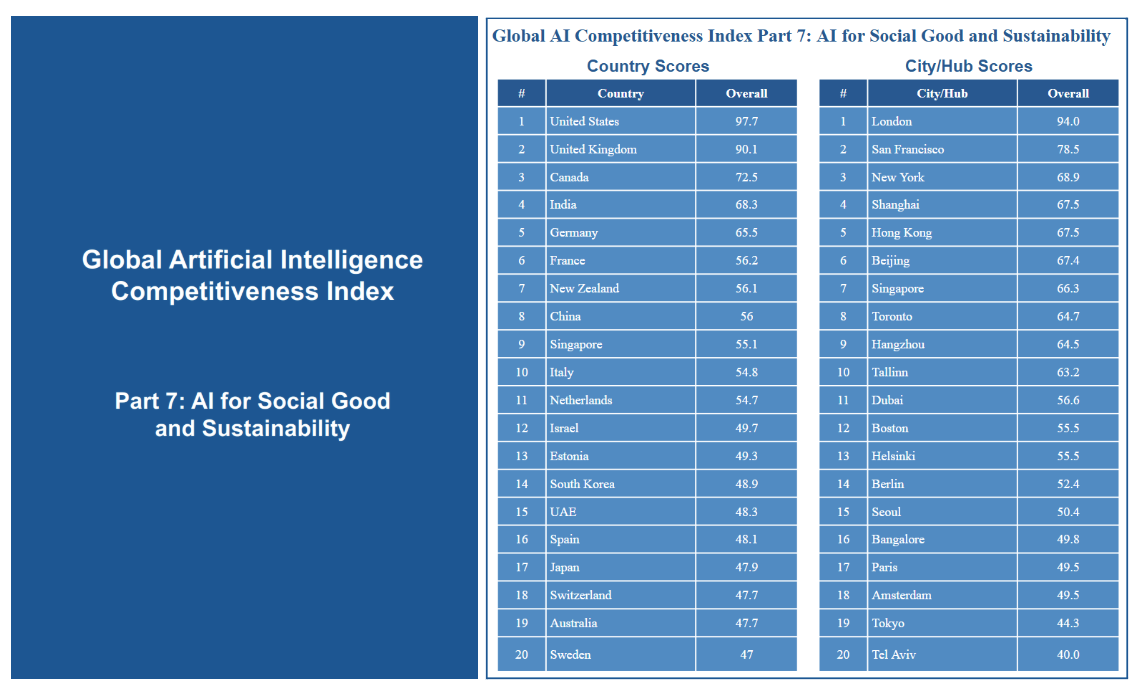
BERLIN, GERMANY, September 10, 2026 /EINPresswire.com/ -- The Global AI Competitiveness Index Consortium has released Part 7: AI for Social Good and Sustainability, ranking 20 countries and 20 city-level innovation hubs on their capacity to deploy AI responsibly and measurably for public, environmental and social benefit.- The United States ranks #1 among countries, followed by the United Kingdom, Canada, India and Germany.
- London leads the city-hub ranking, followed by San Francisco, New York, Shanghai and Hong Kong.
- Leaders pair measurable deployment with public-sector capacity and governance conditions that make AI trusted.
Unlike generic AI rankings, it measures deployment-readiness for public benefit across sustainability, public services, responsible AI, social inclusion and techno-philanthropy: whether jurisdictions have the institutional capacity, governed data, regulatory credibility and ecosystem depth to convert AI capability into public value.
"The true measure of AI competitiveness should not be how advanced the technology is, but how effectively we use it to improve people's lives. The challenge ahead is to ensure that technological progress translates into measurable social progress." — Karen Abudinen, member of the Global AI Competitiveness Index Committee and former Minister of Information Technologies and Communications of Colombia.
The United States leads with 97.7, deploying across every pillar, ahead of the United Kingdom on 90.1, the only other system strong across the full framework. Canada takes third on 72.5, distinguished by having no weak pillar rather than by dominating any one, followed by India on 68.3 for population-scale deployment, Germany on 65.5, and France and New Zealand tied at 56.2 and 56.1.
"The test of AI leadership is not whether governments can announce ambitious programmes, but whether citizens experience services that are better, fairer and worthy of their trust. What this report usefully brings into focus is that public trust is not a soft consideration alongside competitiveness, but the condition that determines whether AI can be used in the public realm at all." — Dame Jenny Shipley DNZM, Index Committee member and former Prime Minister of New Zealand.
"Human capital is an investment, not an expenditure — and the concentration of talent remains the strongest attractor of capital and research funding there is. This report measures it that way, which is the right approach." — Kevin Klowden, Index Committee member; Senior Fellow, Milken Institute; Managing Director, Melcene Advisory.
Beijing ranks sixth among city hubs and Singapore seventh, reflecting operational deployment that catalogued ecosystem density understates, while Toronto, Hangzhou and Tallinn complete the top ten. Tallinn shows that small, coherent digital-government systems can rank alongside far larger metropolitan economies when deployment is measured.
"The strongest innovation hubs are not always the largest; they are often the most connected and the best governed. Hong Kong's position reflects institutional credibility, capital-market depth and connectivity, and the report's finding that measured deployment can outrank catalogued density is an important corrective for how Asian hubs are usually assessed." — King Au, Index Committee member and former Executive Director of the Hong Kong Financial Services Development Council.
"This edition measures a harder thing than AI capability: whether a jurisdiction can turn that capability into public benefit that is governed, deployed and measured. That is where the competitive frontier now sits." — Dmitry Kaminskiy, General Partner of Deep Knowledge Group, Founder of Deep Knowledge Analytics (primary provider of analytics for the Global AI Competitiveness Index series) and co-author of the report.
Public-interest AI carries higher evidentiary, accountability and trust requirements than enterprise adoption: it touches citizens, public services, sensitive data and the allocation of public capital. Sustainability and green technology therefore carry the heaviest weight at 25 per cent, and techno-philanthropy and impact finance enters as a dedicated dimension at 13 per cent, the first edition to treat the allocation of social capital as a measurable competitiveness domain.
"This report shows that in the public and environmental domain the decisive question is whether countries can connect capability, institutions, regulation and trust so that innovation becomes practical benefit rather than technological promise." — Rudolf Scharping, Index Committee member, former Federal Minister of Defence of Germany and Chairman of RSBK AG.
"Where the state deploys AI, it exercises public power, and the guarantees owed to citizens must follow. This report rightly treats accountability, explainability and legal certainty as the foundations of competitiveness rather than as obstacles to it." — Prof. Dr. h.c. Rudolf Mellinghoff, Index Committee member and former President of Germany's Federal Fiscal Court.
Two appendices extend the analysis. Appendix N1 profiles ten AI-driven SDG projects, including UNEP IMEO's MARS methane detection, Google Flood Hub, Qure.ai's TB screening across ninety countries and the GiveDirectly / Togo Novissi programme. Appendix N2 maps AI activity across one hundred social issues and 8,424 classified organisations.
"The methodology here is deliberately demanding: announcements do not count, pilots do not count, and a productivity saving is not an efficiency gain until its conversion into public benefit has been measured." — Prof. Dr. Patrick Glauner, Professor of Artificial Intelligence at Deggendorf Institute of Technology.
Appendix N2 yields the most pointed finding: AI attention follows deployable data and funding constituencies rather than human need. Forty-four per cent of catalogued attention sits on ten of the hundred issues, with a Gini coefficient of 0.65, and two return a measured zero, with no dedicated AI entity: debt distress and predatory lending, and aid and philanthropy transparency. Modern slavery, human trafficking and gender-based violence are among the least-served despite their severity, gaps the report concludes are tractable because the AI functions required already exist densely elsewhere.
"The word 'efficiency' does a great deal of unexamined work in discussions of AI. A system that saves an hour has produced a productivity gain; whether it has produced an efficiency gain depends entirely on what that hour is then used for, and whether anyone measured it." — Sarah Mathews, Group Head of Responsible AI of The Adecco Group and Index Committee member.
Access the full report: www.dkv.global/ai-index/part7
Iain Inkster
Deep Knowledge Analytics Limited
+44 7537 142183
email us here
Legal Disclaimer:
EIN Presswire provides this news content "as is" without warranty of any kind. We do not accept any responsibility or liability for the accuracy, content, images, videos, licenses, completeness, legality, or reliability of the information contained in this article. If you have any complaints or copyright issues related to this article, kindly contact the author above.
